Jake Telman
•
Marketing Lead
January 8, 2026
Before Help Arrives: The Most Dangerous Moments of a School Shooting
January 8, 2026
In the aftermath of a school shooting, there is one story that rarely leads the headlines but makes all the difference: Time.
Time from the first shot to the first causality.
Time from the first call to the first responder.
Time between the decision to act and the moment someone is able to protect the innocent.
In many school shootings, these intervals can be terrifyingly short and mean the difference between life and death. According to a U.S. Secret Service study, two-thirds of school attacks lasted two minutes or less. Nearly half ended within a single minute.
Meanwhile, research on 84 mass shooting incidents shows that police typically arrive on scene in three minutes.
That is fast by most standards. But in situations where a victim can be shot on average every 15 seconds, it can feel like a lifetime.
In today’s school safety plans, there is no single point of failure to blame. It’s about acknowledging a reality that school communities, parents, and first responders already understand: when the worst happens, every second counts.
And for too many victims, the most critical seconds come before help can arrive.
The data shows how quickly shootings unfold, how early the damage occurs, and why response time is one of the most critical variables in school safety today.
The Timeline of Violence
Active shooter incidents in schools unfold with brutal speed:
- 83 percent of attacks lasted five minutes or less
- 68 percent lasted two minutes or less
- 44 percent ended within one minute
In many of the most devastating school shootings, multiple lives were lost in the first 120 seconds. The pattern is consistent across incident reports: harm happens early, and it happens fast.
Even with strong response protocols, there are unavoidable delays. First responders must move through a series of steps before they can confront the threat. These include:
- Receiving the alert from dispatch
- Confirming the threat based on 911 calls, building alarms, or internal reports
- Gathering initial information about the shooter's location, number of suspects, weapons involved, and building layout
- Planning an approach that limits exposure to students and staff
- Clearing rooms and hallways as they move through the building
- Managing radio traffic while keeping communications open with school officials and dispatch
- Locating and engaging the shooter when enough actionable information is available
In the study of 84 mass shootings, the average police response time was three minutes. In most cases, the attacker had already inflicted significant harm before law enforcement could intervene.
The takeaway is clear. If most of the harm happens in the first two minutes, schools need protection that is already in position and ready to act. That requires more than awareness. It requires immediate, on-site response capability.
Closing the Critical Gap
Many schools have recognized this urgency. In response, they have invested in a range of physical security upgrades intended to slow attackers and protect students until help can arrive.
Upgrades vary by district, but often include:
- School-based police officers (SROs) or school guardian programs with trained personnel
- Locked entrance or exit doors during the day
- Door sensors or alerts that notify staff when doors are propped open
- Ballistic film applied to windows to delay or prevent forced entry
- Metal detectors at main entry points, especially in high schools
These steps matter. In many cases, they have helped prevent attackers from gaining access or limited the extent of harm.
But even with these improvements, the first minutes of an active shooting remain the most exposed.
School resource officers are a critical part of campus safety, but even the most capable officer:
- Cannot cover multiple buildings or campuses at once
- May be on the opposite side of campus when an attack begins
- Faces natural delays in locating and closing with the threat
What is needed is not a replacement for what schools are currently using. What is needed is an on-site layer of protection that responds immediately when a threat is confirmed. One that can delay, distract, or disable an attacker before law enforcement gets on scene.
Campus Guardian Angel is built around three operational timing goals:
- Activation in 5 seconds
- Interdiction in 15 seconds
- Incapacitation by 60 seconds
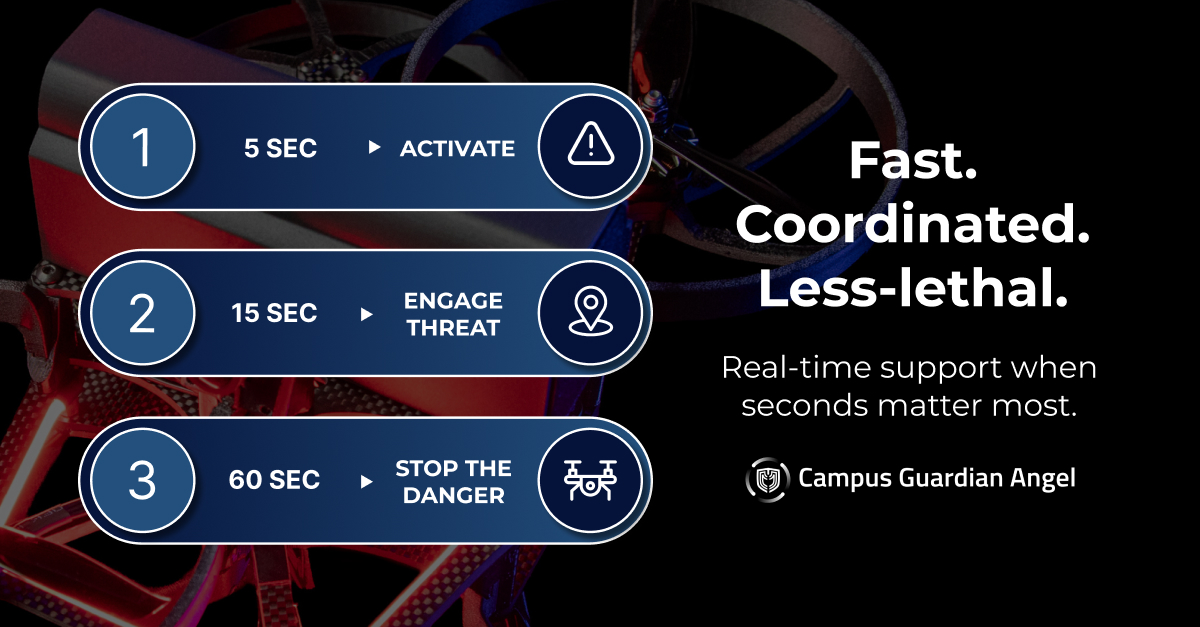
The goal is simple: buy time, reduce harm, and support officers before they arrive. In the most critical moments, speed to stopping the danger is protection.
While arriving as fast as possible can change the outcome of a school shooting, we also support law enforcement with real-time situational awareness. Through live video, voice communication, and tools like the Campus Guardian Angel app, our capability helps responders move faster and safer by:
- Providing live visual intel before they enter the building
- Helping identify the shooter's location and safe zones
- Reducing confusion on arrival by coordinating with staff inside
- Allowing command staff to direct resources dynamically as events unfold
As Chief Rowden of Highland Park ISD Police put it:
“Having a drone that is a whole lot more replaceable than one of my officers going around a corner and seeing that danger, and us being able to respond to that danger before we go round that corner is a lot safer than it is the way we have to do it without drones.”
Situational awareness does not just support the response. It makes faster responses possible.
And when time is the difference between lives saved and lives lost, that speed becomes the foundation of real protection.
This does not mean we abandon the tools we already use. Locked doors, trained officers, and preventative programs all matter. But we must also design for the moments when those tools are not enough. The moments before help arrives. The moments when seconds determine outcomes.
School safety is not a single solution. It is a system. And systems work best when every part is aligned to the reality on the ground. That reality tells us one thing above all: response must be measured in seconds, not minutes.
Campus Guardian Angel was built for that exact window - to activate in seconds, support first responders, and protect students in the moments that matter most.