Justin Marston
•
Founder & CEO
October 7, 2025
PART V: Reducing Gun Trauma by Reducing the FUD
October 22, 2025
An active shooter alarm is typically extremely traumatic for all people involved. Even if the alarm turns out to be false, the people in that moment can still experience it as though it were real, causing fear, uncertainty, and doubt (FUD). Part five of our blog series on reducing gun trauma in schools focuses on reducing the FUD that staff, students and parents are exposed to and so reducing the trauma.
The numbers of both real events and false alarms continue to grow:
- For the three years from 2022 to 2024, there were 990 school shootings, a ten fold rise over a decade earlier. (Source: K-12 School Shooting Database)
- In the 2023 school year alone, there were at least 731 school swatting events. (Source: K-12 School Shooting Database)
- 57% of teens say they are worried about the possibility of a shooting happening at their school, with one-in-four saying they are very worried. (Source: Pew Research)
- 34% of high school teachers say they experienced a gun-related lockdown in the 2022-23 school year. (Source: Pew Research)
- 23% of all teachers say they experienced a lockdown in the 2022-23 school year because of a gun or suspicion of a gun at their school. (Source: Pew Research)
- 21% of Texas high school students and their friends experienced a gun-related lockdown during 2024. (Source: Texas Student Council on School Safety)
Again, it is critical to acknowledge that false alarms cause trauma , not just actual shootings. From Vermont in 2023:
“A day after nearly two dozen Vermont schools received phony threats, many students, teachers and parents were dealing with emotions stemming from the situation... Dickerson [psychiatrist] says stressful situations like school threats and lockdowns can leave lasting impressions on children and teacher, impacting their emotional, behavioral, and even physical health.”
There are multiple phases in a recovery cycle, and individuals recover at varying rates. In our own conversations with school districts, it has become apparent that teachers we have met still have PTSD from false alarms, such as in Round Rock High School from an event 2 years ago, in which someone called in to say he was going to go and shoot up the school. Some comments from teachers and other staff:
- When police responded, they kicked doors in toilet stalls, and teachers believed these sounds to be gunfire, convincing them that it was a real shooting.
- Teachers had no information for 50 minutes until an all-clear was given, which is an extremely long time when crowded into small, dark spaces between classrooms.
- Parents also received very limited information during the lockdown.
At Boerne ISD during a false alarm:
- Parents gained access to emergency communications via an unencrypted radio stream from the Fire Department. When one student self-evacuated and was confronted by police,
- A member of the Fire Department published the phone number of the caller on social media, breaking protocol and increasing the fear for parents.
Swatting events can also be motivated by religious or ethnic prejudices. According to the Anti-Defamation League, there were at least 72 swatting events targeting Jewish institutions during the Summer of 2023 alone.
Mental Health Counseling
As mentioned in a previous installment of this series, schools must provide access to mental health counselors for people impacted by these events, including teachers and students.
SEL programs, or Social and Emotional Learning, are the process of acquiring and applying skills to manage emotions, achieve goals, show empathy, build positive relationships, and make responsible decisions. These and similar training programs can assist students in preparing for or dealing with the stress of SWAT events.
For students who have gone through swatting events, both group and individual counseling can be effective in reducing PTSD, and parents should also be involved in these recovery journeys.
Improved Intelligence
Evaluating the likelihood of calls being hoaxes or swatting events that do not require a full school lockdown is an active area of research. Bizarrely, many swatting events are being called in from overseas, specifically, Ethiopia. Why it’s happening is difficult to discern, but many of these calls are being made by computers rather than actual human beings. There are also instances where many swatting incidents are caused by a single individual or team, such as in Coquitlam, B.C, in 2015, and also in Tennessee in 2022.
Methods to quickly discover obvious hoax calls (e.g., based on call origination, audio patterns, etc.) would reduce the psychological load on staff, parents, and children. This seems like an area in which an AI overlay on the 911 call handling system might provide significant value, quickly detecting repeated fragments and other artifacts that might indicate the call is a recorded replica rather than being a live person about to commit an act of terror.
There is a tension here between the confidentiality of teens in crisis and the need for attribution for swatting calls. Mental health helpline, such as 988 Lifeline, are increasingly being used to report swatting events, because they maintain confidentiality for the caller.
Improved Situational Awareness
During an active shooter alarm, whether it is a swatting incident or a real event, situational awareness is critical to decision-making dominance. In schools today, situational awareness is very limited during the first few minutes of an alarm, as typically no one is monitoring the security cameras. Therefore, there is very little context for 911 operators and other first responders.
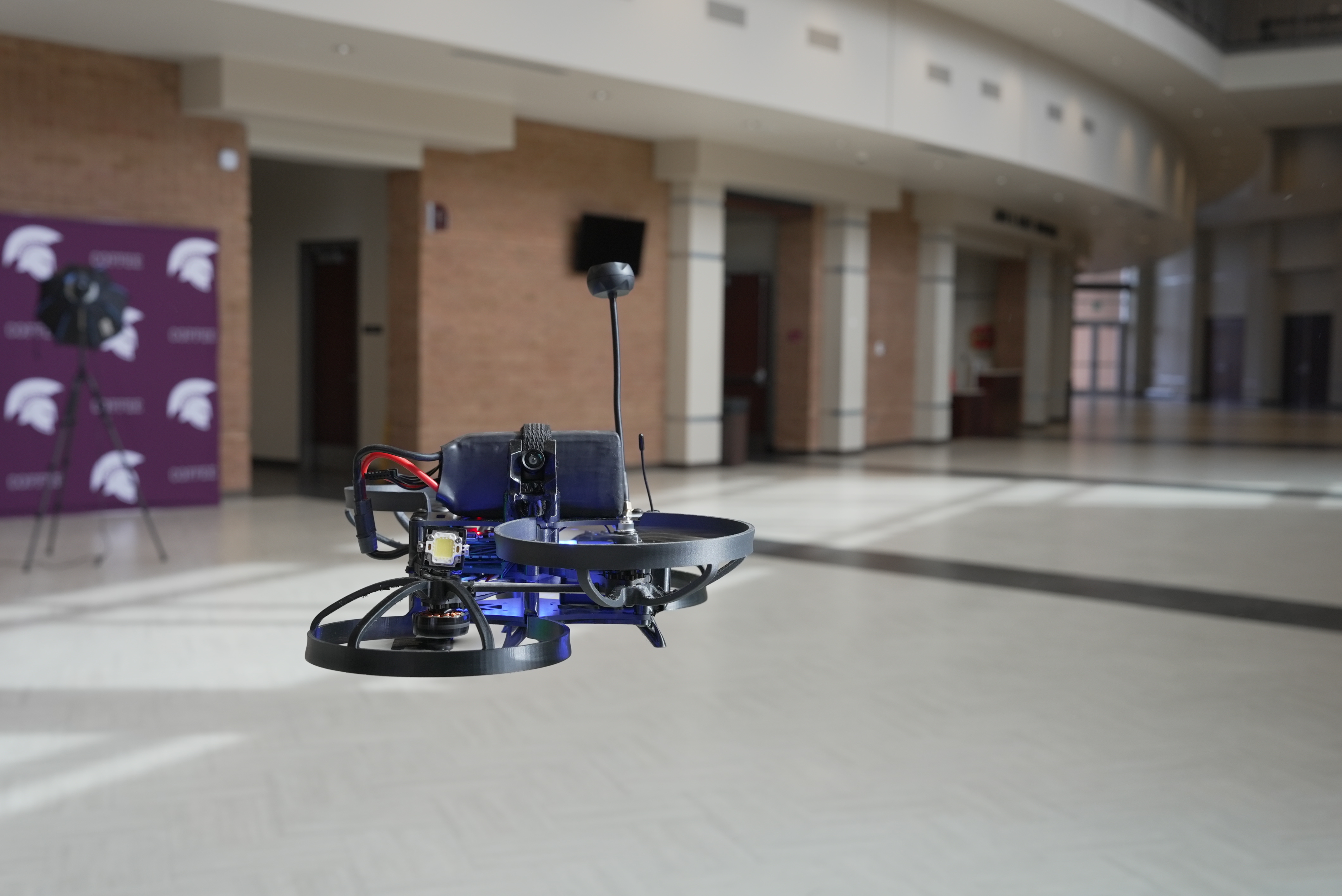
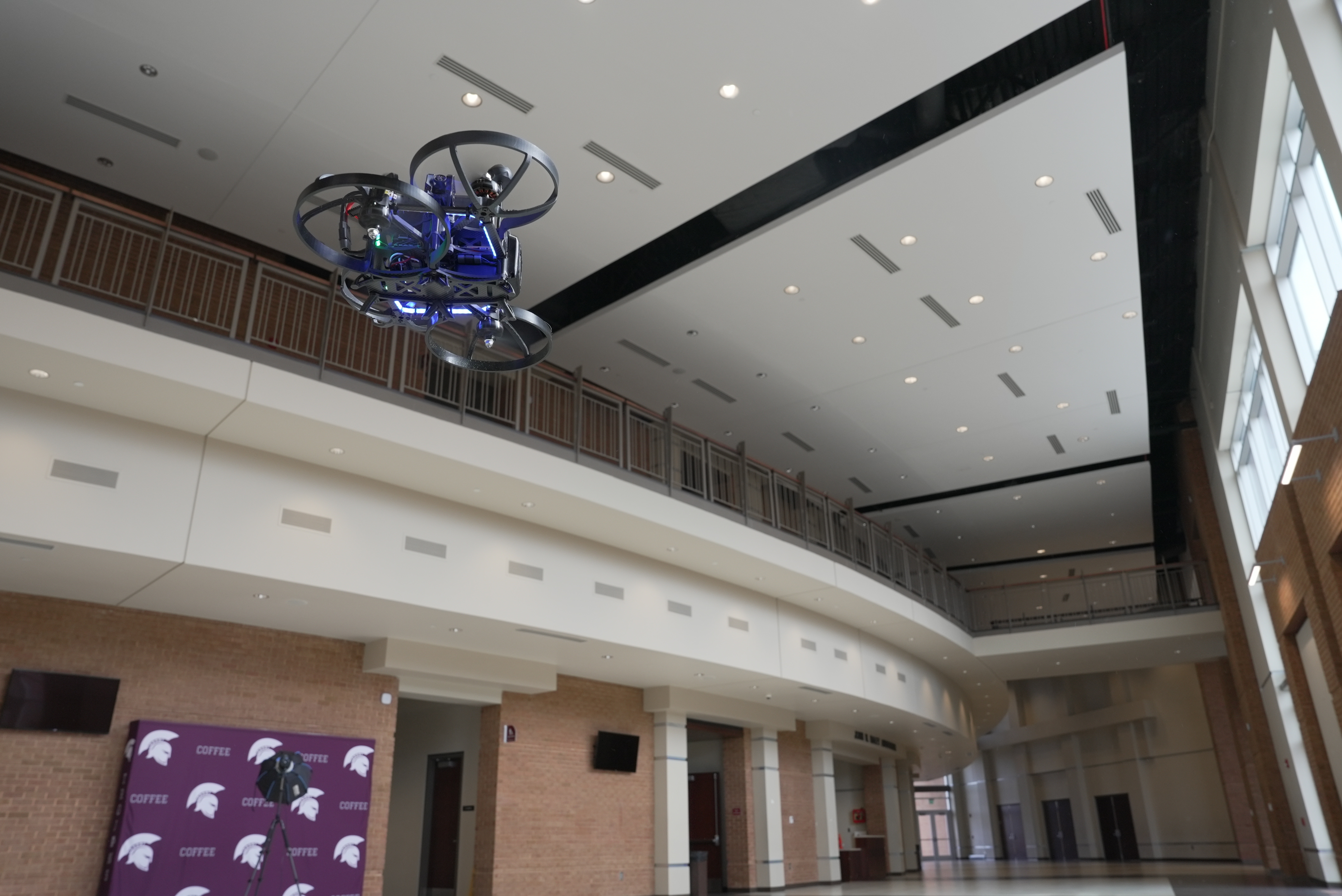
Campus Guardian Angel is a managed service for active shooter response. It incorporates less lethal drones, command and control apps, and an elite team of former special forces and SWAT operators, together with some of the best drone racing pilots in the nation. Campus Guardian Angel dramatically improves situational awareness:
- Our response time is five seconds - far faster than law enforcement officers can arrive on scene , allowing us to build a picture of what’s happening earlier.
- Drones act as mobile cameras, able to search at speed and then loiter in the area of a threat or pursue the threat once discovered.
- We create 3D scan digital twins of the schools we defend ahead of time, which are far more photorealistic and accurate than traditional school maps.
- We tap into all the security cameras at the school once an event is initiated, fusing intelligence into the digital twin in real-time.
- We have an entire team in our central operations center that is immediately assigned to an event, adding around 15 people to the first responders on site.
With this improved situational awareness, there are times when a school doesn’t need to lock down, especially when the threat is exterior to the school grounds or has been called in as a possible swatting incident. Avoiding a school lockdown can reduce trauma for teachers and students.
Faster Resolution
Speed is a big factor in trauma associated with both real events and swatting incidents.
Schools are so large, lockdowns can often take an hour or more to clear, and during that time, teachers and students are often distressed. In our own conversations with teachers, they have taken their class of children into small, dark rooms between classrooms in an attempt to avoid discovery by a shooter. Standing up, huddled in a small dark room that feels like a bomb shelter for an hour is going to increase trauma.
At Campus Guardian Angel, our goal is to resolve swatting incidents faster:
- Our drones can fly much faster than police officers can run, and can take far greater risks, as the drones are expendable.
- The improved situational awareness from our enhanced Common Operating Picture (COP) empowers our ops team with decision dominance.
The faster swatting incidents are over, the faster that kids can return to what they’re supposed to be doing in school: learning.
Improved Communications
Communications matter, and today, they are typically chaotic during initial active shooter alarm responses.
As above, teachers can often believe that a shooting is real when it in fact is not - this can be driven by:
- Sound - such as toilet doors getting banged during clearing, which sounds like gunfire.
- Law Enforcement Presence - the number of officers who have responded, because they have to treat it like it’s real.
- Social Media - rumors and misinformation quickly spread through chat rooms and social media platforms, even during an event.
Again, this is an area in which Campus Guardian Angel can help significantly.
We have multiple centralized ops teams, each in response rooms at our headquarters in Austin. In addition to drone pilots and event commanders, we also have three liaison officers:
- Law Enforcement - giving improved, real-time situational awareness to law enforcement officers.
- Staff - talking to staff via video and text chat, updating them on the situation, and whether there is a real threat.
- Students and Parents - communicating with both students and parents on what the threat is, what actions to take, etc.
Improved communications can help avoid parents going vigilante during swatting incidents, as this is now typical in many swatting events after law enforcement failures at Uvalde, Parkland and others. Swarms of vigilante parents can again increase risk and trauma during a swatting event.
Virtual Training
Training is key to active shooter response - at Campus Guardian Angel, just like an elite hostage rescue unit in the US military, training is a core task area for us, because stopping school shootings is our #1 focus.
One challenge for school districts, however, is how to balance the need for realism during active shooter training with the trauma it can cause. Police officers need to train under duress, not just in empty schools without kids screaming and running, but these actions would traumatize children. From this news piece in WFTV 9 in Florida, it is clear that children in Osceola County Public Schools are seeing increased levels of trauma from active shooter training, especially more realistic and unannounced training.
From Sandy Hook Promise:
“The Sandy Hook Promise Action Fund leads state-level efforts to ensure students are not required to participate in active shooter simulations as part of their school safety exercises. The team is prioritizing this issue because of an ongoing trend. Some policy makers are treating active shooter drills and active shooter simulations as one and the same. And that’s putting children at risk.”
Georgia Institute of Technology’s Social Dynamics and Wellbeing Lab in Nature:
“… this article applies machine learning and interrupted time series analysis to 54 million social media posts, both pre- and post-drills in 114 schools spanning 33 states. ... Results indicate that anxiety, stress, and depression increased by 39–42% following the drills, ... This research, paired with the lack of strong evidence that drills save lives, suggests that proactive school safety strategies may be both more effective, and less detrimental to mental health, than drills.”
From ABC News reporting:
“Active shooter drills have become the norm in schools across the U.S., but experts warn they have the potential to cause more harm than good… They can, however, cause marked damage to mental health and even serve as an instruction manual for potential school shooters, according to some experts… "When you compound actual shootings that kids see on TV all the time with these drills, and with lockdowns in response to new incidents, it's actually not surprising that many American school kids are in crisis. The last thing they need is additional trauma from drills multiple times a year," Burd-Sharps said. "There's absolutely a better way," she added.”
How can Campus Guardian Angel help here?
As described above, Campus Guardian Angel captures a photo-realistic digital twin of each school it defends, such as this one. This is not a computer-generated model or a video, it’s a real school in a 3D ‘video game’ (Unreal Engine, the platform used for games such as Fortnite). We utilize this during our event response to enable our centralized team to have a very accurate map of the school during an event.
At Campus Guardian Angel, we are using these hyper-real 3D scans for training, allowing our pilots to fly around a school in a simulator to practice for a response without having to disrupt the school campus or put hardware (drones) at risk of damage on-site. In fact, professional drone pilots use drone piloting simulators regularly - to practice in general and to practice specific racing courses ahead of arriving on site.
In 2026, we intend to expand our simulator platform to law enforcement officers. This would allow them to:
- Practice active shooter training in virtual reality using the digital twins of schools they guard in real life, whenever they want.
- Run multiple scenarios, with people getting shot, children running down corridors screaming, etc., to prepare for a real event, without causing trauma to children.
- Do multiplayer scenarios with other officers, mixed with AI players for children and teachers, similar to an online video game.
- Train with our drones and central response teams in joint tactical scenarios, utilizing our team in the Austin operations center and collaborating with law enforcement officers on campuses.
- Gain far more accurate recordings and after-action reports from training than can be done in real-world events that do not record everything.
- Practice in front of a computer or with a simulated gun and projector screen to better emulate real life.
- Practice in an augmented reality center we intend to establish in Austin, equipped with VR headsets and motion capture sensors. This allows officers to physically run around their school campus virtually, inside a large warehouse.
We believe that training representatives in high-stress scenarios is crucial to developing competent responses to active shooter events, but these types of trainings should be separated from far less realistic active shooter drills in schools. Students should practice hiding in place without gunshots, fake blood, and people screaming.
Summary
This is the final part in a five-part blog series on reducing trauma from gun violence in schools. We looked at the statistics of school shootings and swatting events, and then covered four areas to reduce trauma:
- Reduce the Occurrences
- Reduce the Killing
- Reduce the Dying
- Reduce the FUD
At Campus Guardian Angel, our primary goal is to save lives in real active shooter events. However, reducing trauma among our next generation of young adults is another important element of our mission as a company.